
The whole story in forty-five seconds.
If you only have a minute, start here.
I began with prediction.
In 2024 I set out to forecast crop prices and map the weather for farmers. I compiled monthly prices for rice, mango and onion, and started building models.
My premise was that farmers know their land well, and what they can’t see from the village is the market. That turned out to be half right.
Palghar, Maharashtra.
A few hours north of Mumbai: coastal plains to the west, forested hills around Jawhar and Mokhada to the east, and a large Adivasi population. Paddy is the monsoon crop. Mango grows in Dahanu and Wada. Most farmers are smallholders.
My family has farmed near Malwada for about forty years. That gave me a way in, and a position I had to account for.
- The farm gateThe farmer is here
- Village buyers
- Wholesale mandi
- Commission agents
- City shops
Each step takes a margin. A farmer selling at the farm gate sees only the first.
Language decided who I could hear.
The fieldwork was informal: conversations in the villages around our farm. Most were in Marathi, which I don’t speak fluently, and farmers opened up only once my father led them. With farmers who spoke Hindi, I could talk directly.
Through my father, in Marathi
Most conversations. I asked him to raise two questions: how confident farmers felt selling to a new buyer, and what they knew of government schemes.
Directly, in Hindi
Fewer conversations, but my own. This is where I heard about the weather.
What they wanted
- Prices, more than weather or soil. Direct, current market prices.
- No daily weather. A daily feed only made them anxious: something to worry about, nothing to do.
What they were up against
- One buyer. The buyer can move on to the next seller. Most farmers can’t.
- Little hope of help from government schemes.
- Data that runs out mid-month, and power cuts that last hours.
- Distrust of outsiders who don’t understand village life.
We were a landowning family talking with people who knew us, in a small, connected circle. I didn’t speak to traders, extension workers or Panchayat officials, and I can’t separate the views of women farmers or of Adivasi farmers whose first language is neither Marathi nor Hindi. No one is named.
Missing information was only part of the problem.
The crux was confidence.
In selling to a buyer they didn’t know. In asking for help from government schemes at all.
A price a farmer can check and point to gives them something to bargain with, and more confidence in their own trade.
The confidence finding is my father’s account of the Marathi conversations, and my reading of it. Neither it nor the weather finding is a measured result.

A message should not feel like an alarm.
141: mango price, four months from now. For more information, visit your nearest Gram Panchayat office.
OK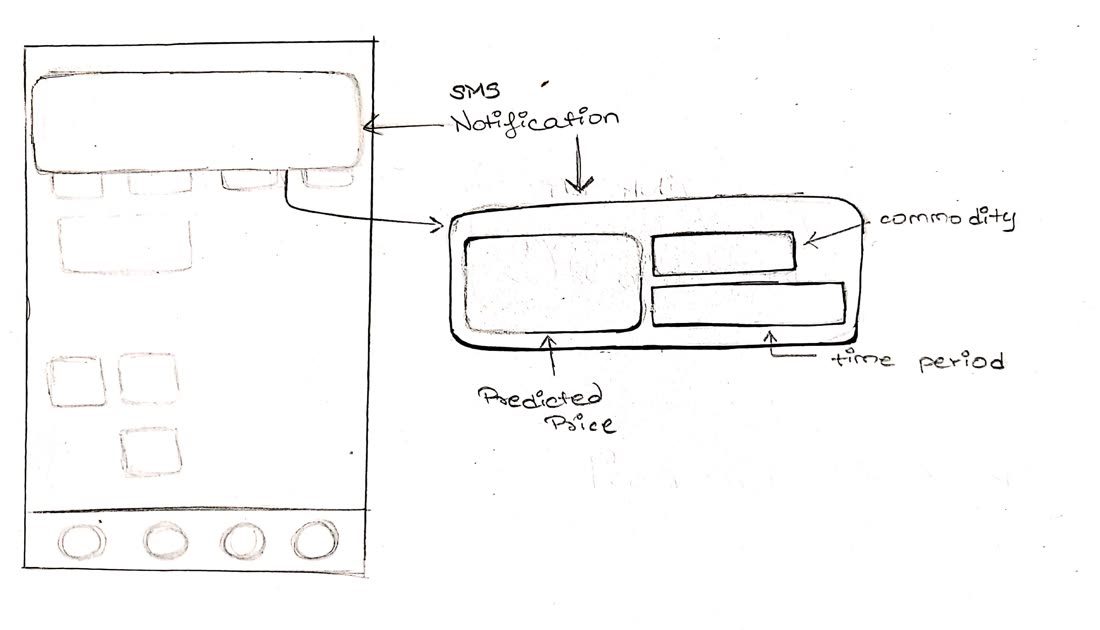
By the end of 2024 I had price forecasts and an SMS concept in Marathi. I showed a small group of farmers a mid-fidelity prototype.
Shown as a pop-up, it felt scary to them, like something they had to rush to act on.
Read it again, though. A number with no unit, four months out, comes first. It gave a farmer nothing to check or point to in front of a buyer. I didn’t see that until 2026.
What I cut.
- 2024The IoT architecture.
Sensors, WiFi modules and cloud servers. None of them exist in remote Palghar, so delivery became SMS.
- 2026A fix that wasn’t a fix.
I first scaled the rice data to match the paddy Minimum Support Price: a calibration to another commodity’s government price, not a unit conversion.
- 2026A flattering baseline.
My first test compared the model only with the same month last year, the weakest comparison there is.
The prices weren’t prices.
Rebuilding the pipeline in 2026, I found every series dropping sharply in 2020: rice and mango to less than half, onion by about a third. A staple crop doesn’t crash like that.
Rice retail price index, 2015 to 2023
Index points, not rupees.
The source was the Labour Bureau’s retail price index. In September 2020 it rebased from 2001 to 2016. Rescale the later rice series by the earlier one’s 2016 average (252.2) and it carries straight on.
What shoppers pay, not what farmers are paid.
The gap holds every margin along the chain. I haven’t found the exact table, so this is a strong inference, not a confirmed fact.
The forecast didn’t reliably beat last month’s price.
For every month from January 2018, I retrained the model on everything before it and compared its forecast with the simplest alternative: repeating last month’s value.
Onion was roughly level. Mango was better in a typical month, but its 80% ranges held the real value only about a quarter of the time.
What this doesn’t show: that forecasting is useless for farmers. These are smooth monthly shop prices, where “same as last month” does well; farmers deal in mandi prices that move daily. And the test isn’t blind: I chose the settings with all the data visible.
For rice, which was closer one month ahead, on average?
Average error one month ahead, 2018 to 2023, on the retail price indices.
The evidence and the farmers pointed the same way: current prices first, forecasts second.
A framework that grows from what farmers ask for.
TerraByte is the start of a knowledge hub for farmers in rural regions: calm, local and public, delivered through local institutions and basic phones. Not an app. One part has flowered. Two are buds.
Market prices
The latest actual price from the mandi or procurement centre the farmer sells to, named and dated so it can be checked and cited.
- Government schemes. A bud. First find out what stops farmers applying: information, paperwork, distrust, or something else.
- Larger environmental disturbances. A bud. Major events that affect a season, never daily weather.
- Whatever farmers ask for next. Not yet grown.
- Every part of it has to be calm, checkable, reachable without a data pack or smartphone, in the farmer’s own language, and earn its place in testing.
Prices are the first module.
The default message leads with the latest actual price, in rupees per quintal, from the mandi the farmer sells to, named and dated. No forecast by default. Whether a line about next month helps is for farmers to decide in testing.
Try the four test cards
Placeholders stand in for last year’s real prices. Read each as if you had onions to sell this week.
Three ways in, none needing data
- SMS. Plain text on any phone, worded without urgency.
- Automated voice call. The same message read aloud, so no reading is needed. Whether a call feels rushed is untested.
- Weekly Panchayat notice. For anyone without messages. A public notice also tells a buyer that farmers have seen the price.
₹ .... onion, per quintal
At your mandi, with the date. Illustrative, no real price shown.Marathi wording is written and checked by native speakers, with Hindi where farmers speak it. It promises no better price: a randomised trial of an SMS price service in Maharashtra found no significant average effect on what farmers received (Fafchamps and Minten, 2012). The question is whether knowing the going rate changes anything, including how confident a farmer feels.
Next: in front of farmers.
The protocol is written but not yet run. Six to eight farmers, including women, people without smartphones and someone whose first language isn’t Marathi, plus Panchayat staff. My father reads every card word for word, because confusion is the finding.
What would change my mind
- If people misread the range, the forecast stays off the message.
- If the price changes nothing about how they sell, the problem is the buyer.
- If it makes no difference to how confident they feel, TerraByte has to look beyond information.
What this can’t claim yet.
- The data are shop price indices, not farm-gate prices, and end in 2023.
- The model doesn’t reliably beat repeating last month’s price.
- The fieldwork was informal, within one family’s network.
- The revised message has not yet been shown to a farmer.

It began as prediction.
It became a project about confidence.